1. Introduction & Overview
This paper presents a novel energy harvesting architecture designed to power Internet of Things (IoT) devices by scavenging ambient electric-field (E-field) energy emitted from conventional fluorescent light troffers. The core innovation lies in using a simple copper plate as a capacitive coupler, placed between the light fixture and the ceiling, to extract usable electrical energy without interfering with the light's operation. The harvested energy is intended to enable battery-less IoT networks for environmental sensing and data transmission.
Key Insights
- Targets the pervasive, always-on electric field around AC-powered fluorescent lights.
- Proposes a non-intrusive, plate-based harvester superior to prior bulky designs.
- Achieves practical energy yield (1.25J in 25min) sufficient for low-power IoT duty cycles.
- Envisions self-sufficient sensor networks for smart building condition monitoring.
2. Core Technology & Principle
2.1 Electric-Field Energy Harvesting (EFEH) Basics
Any conductive material energized by an alternating current (AC) voltage emits a time-varying radial electric field. This varying E-field induces a displacement current ($I_D$) in a nearby conductive object (the harvester plate). The displacement current, governed by Maxwell's equations, allows the transfer of energy via capacitive coupling without a direct conductive path. The harvested AC is then rectified and stored in a capacitor or supercapacitor.
2.2 Proposed Harvester Architecture
The proposed system modifies the Linear Technology parallel plates model. A 50cm x 50cm copper plate is inserted between the ceiling and a standard 4-light fluorescent troffer (4x18W, 220V AC, 50Hz). This plate acts as a capacitive voltage divider within the E-field, creating a potential difference. Crucially, this design is less bulky, does not obstruct light, and simplifies the circuitry compared to earlier attempts.
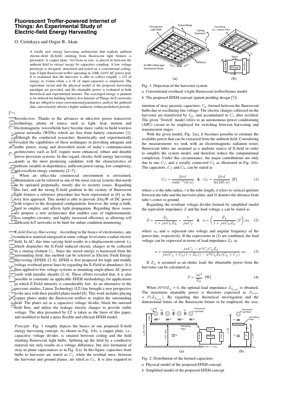
Figure 1 (Conceptual Diagram): Depicts (a) a standard ceiling fluorescent fixture and (b) the proposed harvester setup. The copper plate is shown positioned above the lights. The displacement current $I_D$ flows into a rectifier and storage circuit, powering a sensor node with a switch for duty cycling.
3. Technical Implementation & Modeling
3.1 Equivalent Circuit Model
The physical setup is modeled as a network of stray capacitances (see Fig. 2 in the PDF). Key capacitances include:
- $C_f$: Capacitance between the fluorescent bulbs and the harvesting plate.
- $C_h$: Capacitance between the harvesting plate and the ground (ceiling/metal fixture body).
- $C_b$: Parasitic capacitance between the bulbs and the ground.
The harvester plate and the associated circuitry form a capacitive voltage divider with these stray elements. The theoretical harvestable power is derived from this model.
3.2 Mathematical Formulation
The open-circuit voltage ($V_{oc}$) induced on the harvester plate can be approximated by the voltage divider formula:
$$V_{oc} \approx V_{AC} \cdot \frac{C_f}{C_f + C_h}$$
where $V_{AC}$ is the RMS voltage of the power line. The theoretically available power ($P_{av}$) for an optimal load is given by:
$$P_{av} = \frac{1}{2} \cdot \frac{(\omega C_f V_{AC})^2}{\omega (C_f + C_h)}$$
where $\omega = 2\pi f$ is the angular frequency of the AC source. In practice, losses in the rectifier and matching network reduce the net harvested power.
4. Experimental Setup & Results
4.1 Prototype Configuration
The experimental setup used a standard office ceiling fluorescent troffer. The 50x50cm copper harvester plate was placed parallel to the fixture. The harvesting circuit consisted of a full-wave bridge rectifier, voltage regulation, and a 0.1F supercapacitor as the storage element. Energy accumulation was measured over time.
4.2 Energy Harvesting Performance
Experimental Result Summary
Harvested Energy: Approximately 1.25 Joules accumulated over 25 minutes of continuous operation.
Average Power: Roughly 0.83 mW ($P = E / t = 1.25J / 1500s$).
Storage: 0.1F Supercapacitor.
This energy yield is sufficient to power an ultra-low-power microcontroller (e.g., Texas Instruments MSP430 or Arm Cortex-M0+) and a low-duty-cycle radio (e.g., LoRa or Bluetooth Low Energy) for periodic sensing and transmission tasks, validating the concept for battery-less IoT nodes.
5. Analysis Framework & Case Example
Analyst's Perspective: A Four-Step Critique
Core Insight: This isn't just another energy harvesting paper; it's a pragmatic hack targeting a ubiquitous but overlooked energy source—the "waste" E-field from lighting infrastructure. The authors correctly identify fluorescent troffers, common in commercial buildings, as perennial, grid-connected E-field sources, making them more reliable than sporadic solar or kinetic energy. The shift from high-voltage power lines (the traditional EFEH domain) to low-voltage indoor lighting is a significant and commercially astute pivot.
Logical Flow: The argument is solid: 1) IoT needs perpetual power, 2) Batteries are a bottleneck, 3) Ambient fields are promising but underutilized, 4) Fluorescent lights are ideal targets, 5) Prior designs (e.g., LT's) are flawed, 6) Here's our better, simpler plate design, and 7) It works (1.25J proof). The flow from problem to solution to validation is clear and compelling.
Strengths & Flaws: The major strength is the simplicity and non-intrusiveness of the copper plate solution. It doesn't require modifying the light fixture or wiring, a huge advantage for retrofitting existing buildings. The 0.83mW output, while low, is in the ballpark for modern ultra-low-power IoT chips, as evidenced by platforms like the Arm Cordio RF stack or academic studies on sub-mW sensors. However, the fatal flaw is its core dependency on fluorescent technology, which is being rapidly phased out globally in favor of LED lighting. LEDs, especially well-designed ones, generate negligible 50/60Hz E-fields. This threatens to make the technology obsolete before it matures. The paper also glosses over practical deployment issues like the aesthetics and safety of large metal plates near ceilings.
Actionable Insights: For researchers: Pivot immediately to LED-compatible harvesting. Investigate harvesting from the higher-frequency drivers of LEDs or from the AC mains wiring itself, perhaps using toroidal current transformers. For product developers: This concept has a short-to-medium window of relevance in regions with vast existing fluorescent infrastructure (e.g., older office buildings, warehouses). A hybrid harvester combining this E-field method with a small photovoltaic cell for daylight hours could provide more robust 24/7 power. The core lesson is to design energy harvesters for the infrastructure of the future, not the past.
6. Application Outlook & Future Directions
- Short-term: Deployment in existing commercial buildings with fluorescent lighting for HVAC monitoring, occupancy sensing, and indoor air quality tracking.
- Medium-term: Integration with building management systems (BMS) for fully wireless, maintenance-free sensor networks.
- Research Direction: Adapting the principle to harvest from the E-fields around AC power cables in walls and ceilings, a more universal source than specific light fixtures.
- Technology Evolution: Developing multi-source hybrid harvesters (E-field + light + thermal) to ensure energy continuity as lighting technology transitions and to increase total harvested power for more capable sensors.
- Material Science: Exploring flexible, printable conductive materials to create aesthetically neutral or hidden harvester "skins" instead of rigid copper plates.
7. References
- Paradiso, J. A., & Starner, T. (2005). Energy scavenging for mobile and wireless electronics. IEEE Pervasive Computing, 4(1), 18-27.
- Moghe, R., et al. (2009). A scoping study of electric and magnetic field energy harvesting for powering wireless sensor networks in power grid applications. IEEE Energy Conversion Congress and Exposition.
- Boisseau, S., et al. (2012). Electromagnetic vibration energy harvesting devices for sensor networks. Journal of Physics: Conference Series.
- Linear Technology. (2014). Energy Harvesting from Fluorescent Lights Using LTC3588-1. Application Note 152.
- Cetinkaya, O., & Akan, O. B. (2017). Electric-field energy harvesting for wireless sensor networks. IEEE Circuits and Systems Magazine.
- Arm Holdings. (2023). Ultra-low Power Solutions for the Internet of Things. Retrieved from https://www.arm.com.
- Zhu, J., et al. (2020). Unpaired Image-to-Image Translation using Cycle-Consistent Adversarial Networks. Proceedings of the IEEE International Conference on Computer Vision (ICCV). (Cited as an example of innovative, cross-domain problem-solving analogous to adapting EFEH to new sources).