1. Introduction
This paper presents a novel energy harvesting architecture designed to power Internet of Things (IoT) devices by scavenging ambient electric-field (E-field) energy emitted from conventional fluorescent light fixtures. The core challenge addressed is the power constraint in pervasive IoT networks, where battery replacement or maintenance is impractical. The proposed solution leverages the ubiquitous presence of AC-powered fluorescent troffers in commercial and office environments, transforming a common source of electromagnetic "pollution" into a viable power source for low-power sensors and communication modules.
The research is motivated by the limitations of existing energy harvesting techniques (solar, thermal, vibration) which can be intermittent or environment-dependent. Electric field harvesting, particularly from always-on lighting infrastructure, offers a promising path towards truly battery-less, maintenance-free IoT networks for applications like environmental monitoring, smart building management, and predictive maintenance.
2. E-field Energy Harvesting (EFEH)
EFEH operates on the principle of capacitive coupling. Any conductive material energized by an alternating current (AC) voltage emits a time-varying radial electric field. This varying field induces a displacement current ($I_D$) in a nearby conductive harvester plate. The harvested energy is derived from this displacement current, not from conductive current flow, making it a non-intrusive harvesting method.
2.1. Principle of Operation
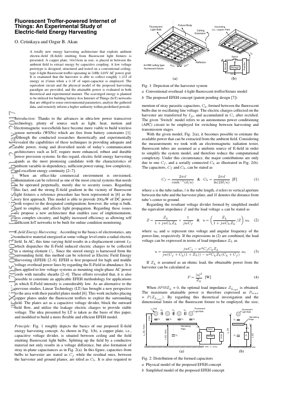
The fundamental model involves a capacitive voltage divider. The ambient E-field between the AC source (fluorescent light fixture) and ground is intercepted by a conductive copper plate. This plate effectively splits the field, creating a potential difference. The system can be modeled by stray capacitances: $C_f$ (between fixture and harvester plate) and $C_h$ (between harvester plate and ground). The harvested voltage ($V_{harv}$) is a fraction of the source voltage ($V_{AC}$), determined by this capacitive divider: $V_{harv} \approx V_{AC} \cdot \frac{C_f}{C_f + C_h}$.
2.2. Proposed Architecture
The authors propose a specific implementation using a 50cm x 50cm copper plate placed between a standard 4-light fluorescent troffer (4x18W, 220V AC, 50Hz) and the ceiling. This design improves upon prior work (e.g., Linear Technology's model) by aiming for easier implementation, less complex circuitry, and higher efficiency without obstructing light. The harvested AC signal is rectified, managed by a power conditioning circuit, and stored in a storage element, such as a supercapacitor.
3. Technical Details & Mathematical Model
The theoretical power ($P_{harv}$) attainable from an EFEH system is governed by the displacement current and the effective impedance of the harvesting circuit. The displacement current can be expressed as $I_D = \omega \cdot C_{eq} \cdot V_{AC}$, where $\omega$ is the angular frequency (2$\pi$f) and $C_{eq}$ is the equivalent coupling capacitance. The maximum harvestable power into an optimal load ($R_L$) is given by $P_{max} = \frac{(I_D)^2 \cdot R_L}{4}$ under impedance matching conditions.
The paper details the equivalent circuit, which includes the source capacitance, the harvester plate capacitance, parasitic capacitances, and the rectifier/load circuit. Key design parameters are the plate area (determining $C_f$), the distance to the fixture and ground (affecting $C_f$ and $C_h$), and the operating frequency of the AC grid.
4. Experimental Setup & Results
4.1. Prototype Configuration
A low-voltage prototype was built and tested. The core harvester was a 50x50 cm copper plate. The power conditioning circuitry included a full-wave bridge rectifier and voltage regulation components. Energy was stored in a 0.1 Farad supercapacitor. The system was deployed in proximity to a standard ceiling-mounted fluorescent troffer.
4.2. Performance Metrics
Experimental Results Summary
- Harvested Energy: Approximately 1.25 Joules
- Charging Time: 25 minutes (for 0.1F supercapacitor)
- Average Harvesting Power: ~0.83 mW (1.25 J / 1500 s)
- Source: 4x18W Fluorescent Troffer (220V AC, 50Hz)
- Harvester Size: 50 cm x 50 cm copper plate
The results demonstrate the feasibility of the approach. The harvested power level (~0.83 mW) is sufficient to intermittently power ultra-low-power IoT sensor nodes, such as those based on Bluetooth Low Energy (BLE) or LoRaWAN protocols, which can operate in the sub-mW to tens of mW range during active transmission bursts.
Chart Description (Implied): A chart would likely show the voltage across the 0.1F supercapacitor rising over the 25-minute charging period, starting from 0V and asymptotically approaching a maximum voltage determined by the circuit design and source field strength. The curve would be characteristic of a capacitor charging through a nearly constant current source (the harvester).
5. Analysis Framework & Case Example
Framework for Evaluating EFEH Viability:
- Source Assessment: Identify target AC-powered fixtures (voltage, frequency, permanence).
- Coupling Design: Determine harvester plate geometry and placement to maximize $C_f$ and the $C_f/(C_f+C_h)$ ratio.
- Power Budget Analysis: Map the harvested power profile (continuous trickle charge) to the duty cycle of the target IoT device (sensor sampling, computation, wireless transmission).
- Storage Sizing: Calculate required storage (supercapacitor/battery) capacity to bridge the gap between energy collection and consumption bursts.
Case Example - Office Temperature/Humidity Sensor:
An IoT sensor node measures temperature and humidity every 5 minutes, processes data, and transmits a 50-byte packet via BLE every 15 minutes.
Power Budget: Sleep current: 5 µA @ 3V. Active sensing/computation: 5 mA for 100ms. BLE transmission: 10 mA for 3ms.
Average Power Consumption: ~15 µW.
Analysis: The EFEH system producing ~830 µW provides a >50x energy surplus, allowing for robust operation and tolerance for inefficiencies. The 0.1F supercapacitor provides ample energy buffer.
6. Future Applications & Directions
- Smart Building IoT Networks: Perpetually powered sensors for HVAC control, occupancy detection, and light monitoring embedded directly in ceiling tiles or light fixtures.
- Industrial Condition Monitoring: Self-powered vibration, temperature, or acoustic emission sensors on factory floor machinery near high-voltage AC lines or lighting.
- Retail & Inventory Management: Battery-less shelf-edge tags or environmental monitors in perpetually lit stores.
- Research Directions:
- Integration of the harvester plate into the light fixture design itself for optimized coupling and aesthetics.
- Development of wide-input-range, ultra-low-quiescent-current power management ICs specifically for nano-power EFEH.
- Exploring harvesting from other ubiquitous AC field sources like power cords, busbars, or electrical panels.
- Hybrid systems combining EFEH with other micro-harvesters (e.g., from LED light) for increased robustness.
7. References
- Paradiso, J. A., & Starner, T. (2005). Energy scavenging for mobile and wireless electronics. IEEE Pervasive Computing.
- Moghe, R., et al. (2009). A scoping study of electric field energy harvesting for powering wireless sensor nodes in power systems. IEEE Energy Conversion Congress and Exposition.
- Boisseau, S., & Despesse, G. (2012). Electric field energy harvesting. Journal of Physics: Conference Series.
- Linear Technology. (2014). Energy Harvesting from Fluorescent Lights Using LTC3108. Application Note 132.
- Cetinkaya, O., & Akan, O. B. (2017). Electric-field energy harvesting in wireless networks. IEEE Wireless Communications.
- MIT Technology Review. (2023). The Next Frontier for the Internet of Things: No Batteries Required. Retrieved from MIT Tech Review website.
- Zhu, J., et al. (2020). Unpaired Image-to-Image Translation using Cycle-Consistent Adversarial Networks. Proceedings of the IEEE International Conference on Computer Vision (ICCV). (Cited as an example of innovative architectural thinking in engineering).
8. Original Analysis & Expert Commentary
Core Insight
This paper isn't just about harvesting microwatts; it's a strategic pivot in IoT infrastructure philosophy. The authors are effectively proposing to turn the built environment's largest, most consistent energy parasite—the AC electromagnetic field surrounding ubiquitous wiring and fixtures—into its nervous system's power supply. The real breakthrough is the recognition of fluorescent troffers not merely as light sources, but as de facto, unintentional wireless power transmitters. This shifts the design paradigm from "adding power sources for sensors" to "instrumenting existing power infrastructure to become self-sensing." It's a move reminiscent of the lateral thinking in works like the CycleGAN paper, which repurposed adversarial networks for unpaired image translation by fundamentally redefining the problem structure. Here, the problem is redefined from "how to power a sensor" to "how to decode the energy already broadcast by the environment."
Logical Flow
The argument is compelling and methodical: (1) Battery-dependence is the Achilles' heel of mass-scale IoT. (2) Ambient energy harvesting is the solution, but most sources are unreliable. (3) The AC electric field is pervasive and constant in indoor environments. (4) Prior attempts were clunky and inefficient. (5) Our innovation: A simple, capacitive plate architecture that is minimally intrusive and leverages the specific geometry of commercial lighting. The flow from problem to solution is clean, and the choice of fluorescent lights as the target is shrewd—they are high-voltage, widely deployed, and often left on for security, making them a perfect "always-on" power beacon.
Strengths & Flaws
Strengths: The elegance and practicality of the design are its greatest assets. Using a standard copper plate and focusing on integration with common troffers demonstrates a clear path to commercialization. The achieved ~0.83 mW is meaningful in the context of modern ultra-low-power radios and duty-cycled sensors, as evidenced by platforms from companies like Everactive or academic research from institutions like UC Berkeley's BWRC. The focus on a supercapacitor for storage is correct, avoiding the cycle-life limitations of batteries for trickle-charge scenarios.
Critical Flaws: The elephant in the room is energy density and form factor. A 50cm x 50cm plate is enormous for a sensor node. This isn't a chip-scale solution; it's a tile-scale one. This severely limits deployment scenarios to new construction or major retrofits where the harvester can be hidden above a drop ceiling. Secondly, the paper is conspicuously silent on safety and regulatory compliance. Intentionally coupling to AC mains fields, even capacitively, raises questions about isolation, fault conditions, and electromagnetic interference (EMI). Would this system pass FCC/CE emissions tests? Unlikely without significant filtering. Finally, the move towards LED lighting, which typically uses lower-voltage, high-frequency drivers, threatens the core assumption of a strong, low-frequency E-field. The harvester's efficiency with LED troffers is a major unanswered question.
Actionable Insights
For product managers and R&D leads, this research offers two clear directives:
- Pursue Strategic Partnerships with Lighting Manufacturers: The future of this technology is not as an add-on, but as a built-in feature. Collaborate with companies like Signify, Acuity Brands, or Zumtobel to integrate optimized harvester electrodes directly into the metal chassis or reflector of next-generation "IoT-ready" light fixtures. This solves the form factor and coupling efficiency problem simultaneously.
- Diversify the Harvesting Portfolio Immediately: Do not bet the farm on E-field from fluorescent lights. Use this as a core, base-load harvesting technology in a hybrid system. Combine it with small photovoltaic cells for LED-lit areas or offices with windows, and with thermoelectric generators for fixtures near HVAC ducts. Research from the EU's EnABLES project emphasizes the necessity of multi-source energy harvesting for reliable operation. Develop a unified power management IC that can seamlessly arbitrate between these sources, much like how modern SoCs manage heterogeneous compute cores.
In conclusion, this paper is a brilliant and provocative piece of engineering that correctly identifies a massive, underutilized energy reservoir. However, its commercial success hinges on moving from a laboratory proof-of-concept attached to a legacy lighting technology, to an integrated, safe, and hybrid solution designed for the built environment of the future. The insight is powerful; the execution must now evolve.