1. Introduction
The paper identifies a significant gap in contemporary household lighting design. While lamps have evolved beyond mere functionality, there is a lack of cohesive, style-consistent lighting solutions that cater to modern demands for personalization, emotional connection (the "home" culture), and stylistic diversity. The authors argue that current designs fail to meet the unified requirement for modularity that allows for user-driven customization and integrated ambient planning.
The core proposition is to apply modular design principles—a proven method in other industries—to innovate household lighting fixtures using OLED (Organic Light-Emitting Diode) technology. The goal is to create a system that enriches design styles while prioritizing users' independent emotional and aesthetic needs.
2. Development of OLED Lighting Technology
OLED is positioned as a revolutionary fourth-generation lighting technology, succeeding incandescent, fluorescent, and LED lighting. Its fundamental advantage lies in being a planar, diffuse light source.
2.1. Technical Advantages of OLED
- Uniform Area Lighting: Emits light evenly across its entire surface, eliminating harsh points and shadows, ideal for ambient illumination.
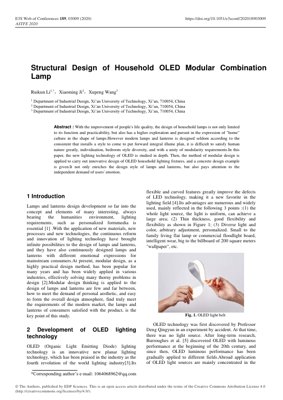
- Ultra-Thin and Flexible Form Factor: Can be made incredibly thin and bent into curves (see Fig. 1: OLED light belt), enabling novel, non-traditional lamp shapes.
- Dynamic Color and Intensity Control: Allows for precise adjustment of color temperature and brightness, supporting personalized lighting scenes.
2.2. Historical Context and Industry Adoption
The paper traces OLED's origins from an accidental discovery to its development for display applications by researchers like Burroughes et al. Major corporations (GE, Panasonic, Philips, LG, Samsung) have heavily invested in OLED R&D, primarily for displays (e.g., LG curved TVs, Samsung folding phones). The authors note that while material and process research is advanced, challenges remain in scaling up volume and improving luminous efficiency for general lighting applications, creating an opportunity for innovative design to drive adoption.
3. Modular Design Methodology
The paper advocates for modular design as the solution to the identified market gap. Modular design involves creating a system from smaller, independent, interchangeable units (modules). Applied to lighting, this means designing a core set of OLED light panels, connectors, frames, and bases that users can combine and reconfigure.
This approach offers several benefits: it allows for easy customization to match personal taste and room decor; simplifies manufacturing and inventory; enables users to upgrade or repair parts rather than replace entire fixtures; and facilitates the creation of a unified yet diverse lighting atmosphere throughout a home.
4. Proposed Design Framework
The authors propose a conceptual framework for an OLED modular combination lamp system.
4.1. Core Design Principles
- Interoperability: Standardized mechanical and electrical interfaces between all modules.
- Scalability: Ability to create small desk lamps or large wall installations from the same core components.
- Aesthetic Coherence: Modules designed with a consistent visual language (materials, finishes, proportions) to ensure any combination looks intentional.
4.2. User-Centric Customization
The framework emphasizes user agency. Through a simple physical or digital configurator, users could select OLED panel shapes (square, rectangular, curved), sizes, mounting options (stand, wall clip, ceiling pendant), and even control schemes (dimmer switch, smartphone app, voice control) to assemble a lamp that is uniquely theirs.
5. Technical Details and Mathematical Modeling
While the PDF lacks explicit formulas, the underlying engineering of such a system can be inferred. Key technical considerations include:
- Power Distribution: A modular system requires a robust bus architecture. The total power $P_{total}$ for a configuration with $n$ modules, each drawing power $P_i$, must be within the power supply's capacity: $P_{total} = \sum_{i=1}^{n} P_i \leq P_{supply\_max}$.
- Thermal Management: OLED efficiency and lifespan are temperature-sensitive. Heat dissipation per module $Q_i$ must be managed so the junction temperature $T_j$ stays within safe limits: $T_j = T_a + \sum Q_i \cdot R_{th\_{i}} < T_{j\_{max}}$, where $T_a$ is ambient temperature and $R_{th}$ is thermal resistance.
- Optical Modeling: The luminance $L_v$ of a combined array should appear uniform. This involves ensuring consistent drive currents and potentially using light-diffusing layers. The overall luminous flux $\Phi_v$ is additive: $\Phi_{v\_{total}} = \sum \Phi_{v\_i}$.
6. Experimental Results and Chart Analysis
The provided PDF content mentions figures but does not include the actual charts. Based on the context, we can describe the likely experimental focus:
- Fig. 1: OLED Light Belt: Likely demonstrates the flexibility and thinness of an OLED panel, showing it bent into a curve or loop, highlighting its form-factor advantage over rigid LED strips or bulbs.
- Fig. 2: LG Curved OLED TV: Serves as a reference point for large-scale, curved OLED application, proving the technology's maturity and visual appeal in a consumer product, albeit in the display sector.
Hypothetical experiments for such a project would measure: 1) Luminous Efficacy (lumens per watt) of the modular OLED panels vs. traditional LEDs. 2) Color Rendering Index (CRI) across different color temperatures. 3) User Preference Studies charting satisfaction scores between custom modular setups and pre-fabricated lamps.
7. Analysis Framework: A Non-Code Case Study
Consider the design of a "Living Room Ambient Light Wall." Using the proposed modular system, a designer or homeowner would follow this framework:
- Define Intent: Create a warm, inviting, and artistic light source that also provides functional reading light.
- Select Modules: Choose a series of rectangular, warm-white (2700K) OLED panels, a set of vertical mounting rails, and smart dimmer modules.
- Configure Layout: Arrange panels in a staggered, non-grid pattern on a digital canvas (like a simple CAD tool), ensuring electrical connectors align.
- Simulate & Refine: Use software to simulate light distribution and intensity on the wall. Adjust panel density and placement.
- Implement: Physically assemble the modules on the rails, connect to power and control system.
- Iterate: Later, swap some panels for colored ones or add a curved panel to change the aesthetic seasonally.
This case study illustrates the framework's flexibility, moving from user need to physical implementation without traditional manufacturing constraints.
8. Future Applications and Development Directions
The potential of modular OLED lighting extends far beyond static home fixtures:
- Architectural Integration: OLED panels as modular, luminous tiles for ceilings, walls, or even furniture surfaces, creating truly immersive environments.
- Healthcare and Wellbeing: Systems that dynamically adjust color temperature and intensity to support circadian rhythms, similar to research in Human-Centric Lighting (HCL).
- Retail and Hospitality: Reconfigurable lighting displays for stores, hotels, or restaurants that can be altered daily to match themes or promotions.
- IoT and Smart Home Convergence: Each module becomes an intelligent node, communicating data (occupancy, ambient light levels) and responding to complex automation routines.
- Sustainability Focus: Designing for full circularity—modules that are easily disassembled, with OLED panels recycled and other components reused.
The key development needed is reducing OLED production costs and improving efficacy to compete with mainstream LEDs, a challenge being tackled by organizations like the U.S. Department of Energy's Solid-State Lighting program.
9. References
- [Cited in PDF] - Reference on evolving lamp design concepts.
- [Cited in PDF] - Reference on the utility of modular design methods.
- [Cited in PDF] - Reference positioning OLED as the "fourth revolution" in lighting.
- [Cited in PDF] - Reference on OLED advantages over LED.
- Burroughes, J. H., et al. (1990). Light-emitting diodes based on conjugated polymers. Nature, 347(6293), 539-541. (Seminal paper on polymer OLEDs).
- [Cited in PDF] - Reference on current OLED technical challenges (volume, efficiency).
- U.S. Department of Energy. (2023). Solid-State Lighting R&D Plan. Retrieved from energy.gov. (Authoritative source on lighting tech roadmaps).
- Isola, P., Zhu, J., Zhou, T., & Efros, A. A. (2017). Image-to-Image Translation with Conditional Adversarial Networks. CVPR. (CycleGAN paper, as an example of a framework enabling user-driven style transformation—analogous to modular aesthetic change).
10. Original Analysis & Expert Commentary
Core Insight: This paper isn't really about inventing a new lamp; it's a strategic blueprint for disrupting the stagnant consumer lighting market by applying software-industry logic—modularity, user configurability, and platform thinking—to a hardware domain. The authors correctly identify that the real pain point isn't a lack of light bulbs, but a lack of personalized light experiences. OLED is merely the most suitable enabling technology, not the hero of the story.
Logical Flow: The argument is sound but surface-level. It follows a classic problem-solution arc: 1) Market fails to meet emotional/personalization needs, 2) Modular design solves this in other fields, 3) OLED tech enables new forms, 4) Therefore, combine them. The flaw is the lack of a rigorous business or engineering feasibility bridge. It glosses over the monumental cost and supply chain challenges of making modular OLED components affordable, a hurdle that has kept OLED lighting niche despite its obvious advantages for over a decade, as noted in DOE SSL reports.
Strengths & Flaws: The paper's strength is its compelling human-centered vision. It shifts the focus from the object (the lamp) to the outcome (the ambiance). The proposed framework is conceptually elegant. Its critical flaw is technological optimism bordering on naivety. It treats OLED as a solved, cheap commodity, which it is not. The "concrete design example" promised in the abstract is conspicuously absent, replaced by generic descriptions. Furthermore, it underplays the complexity of the user interface for configuration—without an intuitive, app-based tool as seamless as the CycleGAN style-transfer model, the modular system could become a frustrating puzzle for average consumers.
Actionable Insights: For industry players, the takeaway is twofold. First, the vision is correct—personalization is the next battleground. Start experimenting with modular concepts using today's cost-effective LED panels and smart controls to build the ecosystem and user understanding. Second, treat this paper as a long-term R&D roadmap. Invest in partnerships with OLED material scientists to co-develop lighting-specific panels that prioritize cost-per-lumen and longevity over the ultra-high resolution needed for displays. The future winner won't be the company with the best OLED chemistry, but the one that masters the integration of modular hardware, intuitive software, and a sustainable lifecycle model.