1. Introduction
Indoor lighting design is critical for both human comfort and energy efficiency. Traditional lighting systems often operate at maximum capacity regardless of occupancy or user needs, leading to significant energy waste. Studies indicate lighting can consume over 15% of a building's total electricity, peaking at nearly 25%.
This paper introduces the Invisible Light Switch (ILS), a novel system that dynamically adjusts illumination based on human presence and gaze direction. By dimming lights outside a user's field of view, ILS achieves substantial energy savings without perceptibly reducing the light level for the occupant, making the saving "invisible."
Key Motivation
Lighting accounts for >15% of building electricity use. In large, sparsely occupied offices, this represents a major, addressable inefficiency.
2. Methodology & System Pipeline
The ILS system processes RGBD (Red-Green-Blue-Depth) input to create a dynamic lighting control model. The overall pipeline is visualized in Figure 2 of the original paper.
2.1. RGBD Data Acquisition & Scene Structuring
An RGBD camera system captures the geometry and appearance of the indoor environment. This data is used to construct a 3D model of the scene, including furniture, walls, and luminaire positions. The photometric properties of materials (reflectance, albedo) are also estimated to model light interaction accurately.
2.2. Human Presence & Head Pose Detection
A human-centric analysis module detects occupants within the scene. Crucially, it estimates each person's head pose to determine their viewing frustum—the volume of space visible from their perspective. This defines which light sources directly contribute to their perceived illumination.
2.3. Radiosity-Based Light Estimation
The core of ILS is a radiosity model. Radiosity is a global illumination algorithm that computes the diffuse inter-reflection of light between surfaces. The model estimates the light level (in Lux) reaching a person's eyes, considering direct light from luminaires and indirect light bounced from walls and objects. Luminaires outside the user's viewing frustum can be dimmed or turned off.
3. Technical Details & Mathematical Formulation
The radiosity method solves for the equilibrium light distribution in an environment. The fundamental radiosity equation for a patch i is:
$B_i = E_i + \rho_i \sum_{j=1}^{n} B_j F_{ji}$
Where:
- $B_i$: Radiosity of patch i (total light leaving the patch).
- $E_i$: Emissivity of patch i (non-zero for light sources).
- $\rho_i$: Reflectivity (albedo) of patch i.
- $F_{ji}$: Form factor from patch j to patch i, representing the fraction of energy leaving j that arrives at i. This is geometrically computed from the scene model.
ILS adapts this model. The "perceived light" $L_p$ for a person at position $\mathbf{p}$ with head orientation $\mathbf{o}$ is estimated by integrating the radiosity values $B_j$ of surfaces j within the viewing frustum $\mathcal{F}(\mathbf{p}, \mathbf{o})$:
$L_p(\mathbf{p}, \mathbf{o}) = \int_{j \in \mathcal{F}(\mathbf{p}, \mathbf{o})} B_j \, V(\mathbf{p}, j) \, dA_j$
Where $V(\mathbf{p}, j)$ is a visibility function. The system then solves for luminaire intensities that keep $L_p$ above a comfort threshold while minimizing total energy $\sum_k I_k$ (power of luminaire k).
4. Experimental Results & Dataset
The authors collected a novel dataset where office workers wore luxmeter devices on their heads to measure illuminance (Lux) at their gaze point, serving as ground truth for perceived light.
Performance Results
- Test Environment: Office room with 8 LED luminaries.
- Baseline Energy (Full ON): 18,585 Watt-hours/day.
- ILS Energy Consumption: 6,206 Watt-hours/day.
- System Overhead: ~1,560 watts for camera/computation.
- Perceived Light Drop: Only ~200 Lux reduction.
Net Saving: ~66% reduction in lighting energy with negligible impact on user experience (from >1200 Lux to ~1000 Lux).
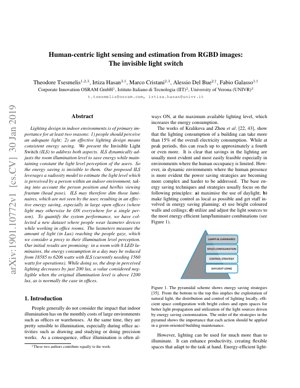
Chart Description (Referencing Fig. 1 & 3): Figure 1 illustrates a pyramid of energy-saving strategies, prioritizing natural light exploitation, local control, space configuration, and efficient light sources. Figure 3 conceptually balances human needs, architecture, and energy efficiency—the triad ILS aims to optimize.
5. Analysis Framework & Example Case
Scenario: A single worker in a large open-plan office with 20 ceiling lights.
- Input: RGBD camera detects one person at desk A, facing their monitor.
- Analysis: Viewing frustum is calculated. It includes lights 1-4 above desk A and the immediate walls.
- Radiosity Solve: The model determines that lights 5-20 contribute minimally to the light reflecting into the user's frustum.
- Action: ILS dims lights 5-20 to 10% power, while keeping lights 1-4 at ~85% power to compensate for lost indirect light.
- Outcome: The worker's perceived illuminance stays at 1050 Lux (vs. 1200 Lux baseline), while energy use drops by ~70% for the lighting circuit.
This case demonstrates the core principle: optimizing for the human sensor (the eyes) rather than the room sensor (a wall-mounted lux meter).
6. Application Outlook & Future Directions
- Smart Buildings & IoT Integration: ILS can be integrated with Building Management Systems (BMS) and IoT networks for holistic energy management, aligning with standards like Project Haystack and Brick Schema.
- Advanced Sensor Fusion: Future systems could incorporate wearable sensors (like the luxmeters used in the dataset) for real-time personalized feedback, creating a closed-loop control system.
- Non-Visual Lighting Effects: Extending the model to control for circadian lighting, influencing melatonin suppression via melanopic illuminance, as researched by the Well Building Standard.
- Machine Learning Enhancement: Replacing or augmenting the radiosity solver with a deep learning model (e.g., a neural renderer) could improve speed and adaptability to dynamic scenes, similar to advances in NeRF (Neural Radiance Fields).
- Scalability & Privacy: Developing decentralized, privacy-preserving versions that use on-edge processing for human detection without storing identifiable video data.
7. References
- Tsesmelis, T., Hasan, I., Cristani, M., Del Bue, A., & Galasso, F. (2019). Human-centric light sensing and estimation from RGBD images: The invisible light switch. arXiv preprint arXiv:1901.10772.
- International Association of Lighting Designers (IALD). (2018). Lighting Design Guidelines.
- Kralikova, R., & Zhou, J. (2017). Energy consumption analysis for lighting in office buildings. Energy and Buildings, 154, 561-568.
- Mildenhall, B., et al. (2020). NeRF: Representing Scenes as Neural Radiance Fields for View Synthesis. ECCV.
- Well Building Standard. (2022). Light Concept v2. International WELL Building Institute.
8. Expert Analysis & Critique
Core Insight: The ILS paper is a clever hack on a classic problem. It doesn't invent new computer vision or graphics algorithms but repackages a decades-old radiosity method into a human-in-the-loop control system. The real innovation is the shift in optimization target: from uniform room illuminance to personalized, gaze-contingent light perception. This is a classic example of a "human-centric AI" application that directly tackles the energy-comfort trade-off.
Logical Flow: The logic is sound: 1) Map the scene, 2) Find the people and where they're looking, 3) Use physics (radiosity) to model which lights affect their view, 4) Dim the rest. The pipeline in Figure 2 is straightforward. However, the paper glosses over the significant engineering challenges: robust real-time head pose estimation in varied office settings, accurate material property estimation from RGBD, and the computational cost of solving even a coarse radiosity system dynamically.
Strengths & Flaws:
Strengths: The empirical approach with a custom luxmeter dataset is a major strength—it moves beyond simulation. The reported ~66% energy savings are compelling and align with the intuitive waste in large, sparse offices. The concept is elegantly simple for the end-user (the saving is "invisible").
Flaws: The elephant in the room is the 1,560-watt system overhead. For a system saving ~12,000 watt-hours/day, this overhead consumes a significant portion of the savings. The economics only work in large spaces. The reliance on a single, central RGBD camera is a privacy and robustness nightmare. What happens with occlusions, multiple people, or someone working on a couch? The radiosity model assumes diffuse surfaces—a major simplification that breaks down with glossy monitors or windows.
Actionable Insights: For practitioners, this research is a proof-of-concept, not a plug-and-play product. The key takeaway is the design principle: optimize for the human visual field. A near-term, deployable strategy could be a simplified version using cheaper PIR/motion sensors and desk-level occupancy to implement coarse zone-based dimming, inspired by ILS's logic. For researchers, the future lies in hybrid models: use a lightweight neural network (inspired by the rapid progress in implicit scene representation like NeRF) to approximate the radiosity function in real-time, and pair it with privacy-respecting, distributed mmWave radar for presence and pose detection, as explored by MIT's Computer Science and AI Laboratory (CSAIL) for in-home sensing. The ILS concept is a solid foundation, but its real-world impact hinges on solving the practical bottlenecks of cost, privacy, and computational efficiency.