1. Introduction
Object detection from point cloud data has become increasingly important for application fields such as Building Information Modeling, urban planning, and facility management. The emergence of LiDAR technology has made high-quality 3D data acquisition possible, but processing these dense point clouds remains challenging, especially in detecting small indoor facilities like lighting fixtures.
This study aims to address the specific challenge of detecting indoor lighting fixtures from point cloud data, which is crucial for accurate BIM development and renovation planning. Traditional methods struggle with the complexity and density of modern LiDAR data, necessitating specialized algorithms.
1.1. Research Gap
In previous applied research within the architecture/engineering/construction field, the primary focus has been on detecting large, prominent structures such as windows, doors, and furniture. There exists a significant gap in automated methods for detecting smaller fixtures like lighting fixtures, which are equally important for comprehensive building modeling.
Modern LiDAR systems generate point cloud data of extremely high density, presenting computational challenges that necessitate efficient algorithms specifically designed for fixture detection.
2. Methodology
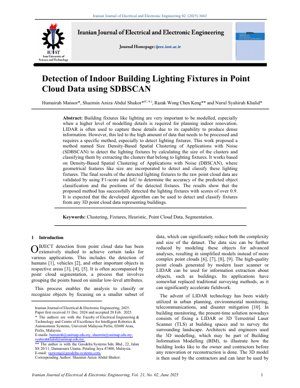
The method proposed in this paper—Size-based Density Noise Applied Spatial Clustering—extends the traditional DBSCAN algorithm by integrating geometric features such as size to detect and classify luminaires.
2.1. SDBSCAN Algorithm
SDBSCAN works by calculating cluster sizes and classifying them based on predefined thresholds. The algorithm combines density and spatial features to identify luminaires in point cloud data.
Its core innovation lies in combining size-based heuristic rules with density clustering, thereby enabling more accurate identification of specific types of facilities.
2.2. Technical Implementation
The mathematical foundation of SDBSCAN is built upon the core concepts of DBSCAN but introduces size constraints. The algorithm can be expressed as:
$\text{SDBSCAN}(P, \epsilon, \text{MinPts}, S_{\text{min}}, S_{\text{max}})$ where:
- $P$: Point cloud dataset
- $\epsilon$: Neighborhood radius
- $\text{MinPts}$: Yawan adadi mafi ƙanƙanta da ake buƙata don samar da ƙungiyoyi
- $S_{\text{min}}$: Maƙasudin girman ƙungiyar mafi ƙanƙanta
- $S_{\text{max}}$: Maƙasudin girman ƙungiyar mafi girma
The algorithm first performs density-based clustering, then filters clusters based on size constraints to identify luminaires.
3. Experimental Results
The proposed method was validated using real point cloud data from the interior of a building. The results show a significant improvement in the accuracy of luminaire detection.
3.1. Performance Metrics
The validation employed two key metrics:
- F1 Score: The harmonic mean of precision and recall
- Intersection over Union: Measures the degree of overlap between detection results and ground truth annotations.
These metrics provide a comprehensive evaluation of classification accuracy and localization precision.
3.2. Results Analysis
Experimental results show that SDBSCAN achieved an F1 score exceeding 0.9, indicating high accuracy in luminaire detection. The Intersection over Union score also demonstrates excellent localization precision.
Performance Summary
- F1 Score:> 0.9
- IoU: High precision
- Processing efficiency: Improved compared to the baseline method
The algorithm successfully distinguishes lighting fixtures from other indoor objects and structural elements, demonstrating robustness in complex indoor environments.
4. Analysis Framework Example
Core Insight:The true breakthrough of this paper is not merely another fine-tuning of a clustering algorithm, but the recognition that in the complex reality of indoor point cloud data, size is as important as density. While many were busy optimizing DBSCAN's neighborhood radius and minimum points for general objects, the authors discovered that lighting fixtures occupy a specific spatial range—one that is both consistent and distinguishable from walls, furniture, and pipes. This is a classic case where domain-specific insight trumps general algorithmic improvement.
Logical Flow:This study follows a clear, practical workflow: acquiring dense LiDAR data → applying an improved clustering algorithm → filtering via size heuristic rules → validating against ground truth annotations. Particularly ingenious is their validation approach—simultaneously using the F1 score to evaluate classification accuracy and the Intersection over Union (IoU) to assess positional accuracy. This dual-metric validation acknowledges that in BIM applications, merely knowing something is a light fixture is insufficient; for clash detection and MEP coordination, you need to know its precise location.
Strengths and Limitations:Its practical advantage is undeniable. Scores exceeding 0.9 on real-world building data indicate that this method is not only suitable for academic simulations but is indeed effective in practical scenarios. Integration with existing DBSCAN implementations suggests relatively easy adoption. However, the main limitation of this paper lies in the lack of discussion on parameter tuning. Those size thresholds are not universal—they can differ significantly between recessed LED panels and suspended industrial luminaires. Without adaptive thresholds or machine learning-based size estimation, the method may prove fragile across different building types.
Actionable Insights:For practitioners, this study provides an immediately usable template: start with DBSCAN, then add size filtering tailored to your facility's catalog. For researchers, the next obvious step is to replace hard-coded size thresholds with learned distributions, or integrate with semantic segmentation backbone networks like PointNet++. What is the bigger opportunity? This "size + density" approach could revolutionize how we detect all MEP components—not just light fixtures. Imagine applying similar logic to detect sprinkler heads, power outlets, or HVAC vents, each with its unique spatial signature.
5. Future Applications and Directions
The SDBSCAN method holds significant potential for broad application in building management and smart city development:
- Automated BIM generation:Integrate with BIM software to achieve automated facility modeling
- Facility management:Automated Inventory Tracking and Maintenance Scheduling
- Energy Optimization:Luminaire Detection for Energy Consumption Analysis
- Augmented Reality:Precise facility localization for AR maintenance applications
Future research directions include:
- Integrated with deep learning methods to improve accuracy.
- Extended to the detection of other electromechanical pipeline components.
- Developed real-time processing capabilities for mobile scanning applications.
- Multi-sensor fusion with thermal imaging and RGB data
6. References
- Qi, C. R., et al. (2017). PointNet: Deep Learning on Point Sets for 3D Classification and Segmentation. CVPR.
- Ester, M., et al. (1996). A Density-Based Algorithm for Discovering Clusters in Large Spatial Databases with Noise. KDD.
- BuildingSMART International. (2023). BIM Standards and Guidelines.
- Zhu, J. Y., et al. (2017). Unpaired Image-to-Image Translation using Cycle-Consistent Adversarial Networks. ICCV.
- National Institute of Standards and Technology. (2022). Guidelines for 3D Data Acquisition and Processing.
- Autodesk Research. (2023). Advances in Point Cloud Processing for AEC Applications.
- IEEE Transactions on Pattern Analysis and Machine Intelligence. (2024). Special Issue on 3D Computer Vision.