Table of Contents
1. Introduction
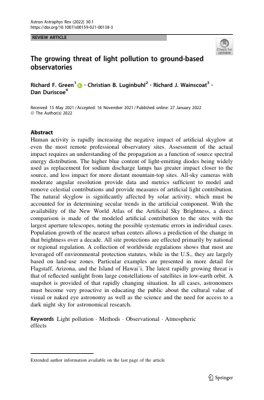
Ayyukan ɗan adam yana ƙara haɓaka mummunan tasirin hasken sama na wucin gadi cikin sauri, har ma a mafi nisa na wuraren binciken taurari na ƙwararru. Wannan labarin bita yana kimanta ƙaruwar barazanar gurɓataccen haske ga ilmin taurari na tushen ƙasa, yana mai da hankali kan yaduwar hasken wucin gadi, dabarun aunawa, tasirin tushen LED na zamani, da kuma yanayin tsarin doka. Aikin ya nuna muhimmancin buƙatar matakan riga-kafi don kare dare don binciken kimiyya da kuma al'adun gargajiya.
2. Metrics of Astronomical Impact
Quantifying light pollution requires standardized metrics that translate physical measurements into meaningful indicators of impact on astronomical observations.
2.1 Measuring Light
Ana auna haske ta amfani da ma'aunin radiometric (na zahiri) da photometric (amfanin idon mutum). Don ilmin taurari, ma'aunin da ya dace sau da yawa shi ne hasken sararin sama, wanda aka bayyana shi da ma'auni a kowace murabba'in arcsecond (mag/arcsec²). Canzawa daga luminance (cd/m²) zuwa ma'aunin taurari ana bayar da shi ta: $m_{v} = -16.57 - 2.5 \log_{10}(L_{v})$, inda $L_{v}$ shine luminance.
2.2 Measuring Impact
Ana auna tasiri ta hanyar lalacewar sigina-zuwa-amo (SNR) na tushen samaniya. Ma'auni mai mahimmanci shi ne karuwar hayaniyar bayan gida na sama, wanda ke rage bambanci ga abubuwa masu rauni. Ma'aunin iyaka na na'urar hangen nesa yana shafar kai tsaye hasken sararin sama.
3. Propagation of Artificial Light and Dependence on Source Type
The artificial sky brightness at an observatory depends on the amount, distribution, spectrum, and distance of light sources, as well as atmospheric conditions.
3.1 Sky Brightness vs. Lighting Amount
Sky brightness is approximately linearly related to the total upward-directed luminous flux from a region. Reducing total lumen output is a primary mitigation strategy.
3.2 Sky Brightness vs. Fixture Shielding
Fixtures ya kufanya mwanga usiende juu ya ndege ya usawa kabisa ndizo bora zaidi. Fixtures zisizo na kinga vizuri zinaweza kuongeza mwangaza wa anga kwa mara 3-10 ikilinganishwa na zile zenye kinga nzuri kwa pato sawa la lumen.
3.3 Sky Brightness vs. Distance
For a point source, artificial sky brightness typically decays with distance $d$ according to an approximate $d^{-2.5}$ law for small distances, transitioning to a $d^{-2}$ law at larger distances due to atmospheric scattering and absorption.
3.4 Sky Brightness vs. Lamp Spectrum
The spectral power distribution (SPD) of a light source critically affects skyglow. Rayleigh scattering scales as $\lambda^{-4}$, making shorter wavelengths (blue light) scatter much more efficiently. The widespread adoption of white LEDs, rich in blue light, has increased the near-field skyglow impact compared to older sodium lamps, though the effect diminishes with distance due to atmospheric extinction.
4. Field Measurements of Artificial Night Sky Brightness
Direct measurement is essential for validating models and tracking trends.
4.1 Quantitative Sky Quality Indicators
Common indicators include the Sky Quality Meter (SQM) reading in mag/arcsec², the Bortle Dark-Sky Scale (1-9), and the all-sky camera systems that provide angularly resolved data. The natural skyglow, primarily from airglow and zodiacal light, must be subtracted to isolate the artificial component.
4.2 Examples
The paper references data from sites like Kitt Peak and Mauna Kea, showing long-term trends. The New World Atlas of Artificial Night Sky Brightness (Falchi et al., 2016) provides a global modeled baseline for comparison.
5. Sky Brightness Measurements and Impact of Artificial Sources
Combining measurements with population growth models allows for predictions of future sky brightness. For many major observatories, the dominant light pollution threat comes from the nearest urban center, and its growth rate is a key predictor. The paper notes systematic errors in individual site assessments within the World Atlas, emphasizing the need for local calibration.
6. Public Policy, Codes, and Enforcement
Regulation is the primary tool for protecting observatory sites.
6.1 Light Pollution/Lighting Regulation
Globally, regulations are often based on environmental protection frameworks. In the United States, they are frequently tied to local land-use zoning. Effective regulations specify limits on total lumen output, require full-cutoff shielding, mandate specific spectral power distributions (e.g., limiting blue light emission), and set curfews for non-essential lighting.
6.2 Two Detailed Examples
6.2.1 Flagstaff, Arizona USA
Flagstaff, gida ne Lowell Observatory, ta kafa dokar hasken waje ta farko a duniya a shekara ta 1958. Nasararta ta dogara ne akan ci gaba da sabuntawa, shigar da al'umma, da kuma ka'idoji masu tilastawa waɗanda suka kiyaye sararin samaniya duhu duk da ci gaban birni.
6.2.2 Maunakea, Hawaii USA
ʻO ka mālama ʻana iā Maunakea e pili ana i nā lula pae mokuʻāina (Hawaii Administrative Rules, Chapter 13-146) e hoʻoponopono ana i nā kukui ma ka mokupuni ʻo Hawaiʻi. ʻO ia hoʻi nā palena paʻa i ka ʻikekū hoʻonui i ka mālamalama polū a me nā koi no nā mea hoʻonoho kukui pale, e hōʻike ana i kahi ala mua, hoʻokumu ʻia ma ka ʻepekema.
7. Satellite Constellations in Low-Earth Orbit
The rapid deployment of mega-constellations (e.g., SpaceX Starlink, OneWeb) presents a new and rapidly evolving threat. Reflected sunlight from these satellites creates bright, moving trails that can saturate detectors and ruin long-exposure astronomical images. Mitigation efforts include satellite operators developing darker coatings and observatories developing software to mask trails, but the fundamental conflict between satellite broadband and pristine skies remains largely unresolved.
8. Core Insight & Analyst's Perspective
Core Insight: This paper delivers a stark, uncomfortable truth: the fight against ground-based light pollution, while challenging, is a known game with established rules (shielding, spectrum control, ordinances). The real existential crisis for optical astronomy is the double-whammy of the global LED transition combined with the uncontrolled proliferation of LEO satellite constellations. We are moving from a diffuse, mitigable glow to a sky punctured by thousands of uncontrollable moving dots. The regulatory frameworks painstakingly built over decades for terrestrial sources are utterly useless against this orbital threat.
Logical Flow: The authors expertly build their case from first principles (metrics and propagation) to current state (measurements and models) to future threats (satellites). The logical chain is impeccable: 1) Define how we measure the problem. 2) Show how modern LEDs change the equation. 3) Demonstrate that even "protected" sites are getting brighter. 4) Argue that terrestrial regulations can work (see Flagstaff). 5) Drop the bombshell that all this groundwork may be rendered obsolete by a new, orbital-scale problem. The flow is a masterclass in escalating concern.
Strengths & Flaws:
Strengths: The paper's greatest strength is its synthesis. It connects atmospheric physics (Rayleigh scattering: $I \propto \lambda^{-4}$) directly to public policy, a link often missing. The use of the New World Atlas provides crucial global context. The detailed case studies (Flagstaff, Hawaii) are not just anecdotes but proof-of-concept for mitigation.
Critical Flaw: The treatment of satellite constellations, while included, feels appended rather than integrated. Given its stated status as the "latest rapidly growing threat," it deserves a parallel analytical framework: metrics for satellite impact (e.g., trail density, saturation probability), propagation models for reflected light, and a serious discussion of international space law versus local lighting ordinances. This section is diagnostic but not yet prescriptive enough for the scale of the problem. As noted in the IAU's report on satellite constellations, the astronomical community lacks a unified, quantitative impact assessment model that can be used in regulatory debates with satellite operators and agencies like the FCC and ITU.
Actionable Insights: For observatory directors and advocacy groups like the International Dark-Sky Association (IDA), the playbook is clear but demands a dual-track strategy:
1. Double Down on Terrestrial Mitigation: Use the data here to push for ordinances that not only mandate shielding but explicitly cap Correlated Color Temperature (CCT) – often a proxy for blue light content – at 3000K or lower (IDA recommendation). Lobby for the adoption of standards like the Illuminating Engineering Society's (IES) Model Lighting Ordinance.
2. Elevate the Satellite Fight to a Diplomatic Level: Ground-based pollution is a local/regional governance issue. Satellite pollution is a global commons issue. Astronomers must move beyond technical discussions with individual companies. The goal must be to establish brightness and orbital density limits through bodies like the United Nations Committee on the Peaceful Uses of Outer Space (COPUOS), framing dark skies as a cultural and scientific heritage issue akin to World Heritage sites. The precedent exists in the protection of radio astronomy quiet zones.
The paper implicitly argues that astronomy's traditional reactive posture is untenable. The community must become aggressively proactive, translating complex photometric data into public narratives about lost stars and threatened discovery. The future of ground-based astronomy depends less on bigger mirrors and more on sharper political and public engagement strategies.
9. Technical Details & Mathematical Models
The core physical model for artificial sky brightness $B_{art}$ from a city at distance $d$ involves integrating the contribution from all light sources, considering atmospheric scattering. A simplified form for a uniform city is often expressed as:
$B_{art}(d) \propto \frac{F_{up} \cdot T(\lambda)}{d^{2}} \cdot \int_{0}^{\infty} \frac{\sigma_{scat}(\lambda, z)}{\sin(\alpha)} \, dz$
where:
$F_{up}$ is the total upward flux,
$T(\lambda)$ is atmospheric transmission,
$\sigma_{scat}$ ni kiwango cha kutawanyika (Rayleigh + Mie),
$\alpha$ ni pembe ya mwinuko, na
$z$ ni urefu katika angahewa.
Utegemezi muhimu wa wigo huingia kupitia $\sigma_{scat}^{Rayleigh} \propto \lambda^{-4}$ na SPD ya chanzo $S(\lambda)$. Athari ya kubadilisha kutoka taa ya sodiamu (upana mwembamba karibu ~589 nm) hadi LED nyeupe (upana mpana na kilele cha bluu ~450 nm) inaweza kupimwa kwa kulinganisha viunganishi vilivyopimwa: $\int S(\lambda) \cdot \lambda^{-4} \, d\lambda$.
10. Experimental Results & Data Analysis
The paper cites results from all-sky camera networks and SQM measurements. Key findings include:
- Trend Analysis: A many observatory sites, the artificial component of sky brightness is increasing at a rate of ~2-10% per year, roughly tracking local population and GDP growth.
- LED Impact: Near cities, the transition to LEDs has increased skyglow in photopic (human-eye) units despite reductions in total lumen output, due to the enhanced scattering of blue light. The effect is less pronounced at distant mountain-top sites where atmospheric extinction filters more blue light.
- Model Validation: Comparisons between the New World Atlas predictions and on-site measurements show general agreement but with significant local deviations (±0.3 mag/arcsec²), underscoring the need for site-specific monitoring.
- Satellite Trails: Early data on satellite constellation impacts show that in twilight hours, the density of visible satellite trails has increased dramatically. Simulations suggest that in the near future, a significant fraction of long-exposure images from wide-field survey telescopes like Vera C. Rubin Observatory could be affected.
11. Analysis Framework: A Case Study
Scenario: A regional planning commission is considering a proposal to retrofit all streetlights in a county 150 km from a major observatory with 4000K LEDs. The observatory claims this will significantly degrade its sky quality.
Framework for Impact Assessment:
- Baseline Measurement: Use SQM or all-sky camera data to establish current sky brightness at the observatory (e.g., 21.5 mag/arcsec²).
- Source Inventory: Catalog the total current upward luminous flux from the county using existing fixture types (e.g., HPS lamps).
- Spectral Shift Calculation: Calculate the effective scattering-weighted flux for both the old (HPS) and new (LED) sources.
- HPS: $F_{eff, HPS} = F_{up, HPS} \cdot k_{HPS}$ where $k_{HPS}$ is the spectral weighting factor (~1 for a reference).
- LED: $F_{eff, LED} = F_{up, LED} \cdot k_{LED}$. For a 4000K LED, $k_{LED}$ can be 1.5-2.5 times higher than $k_{HPS}$ due to blue content.
- Propagation Model: Apply a distance-based model (e.g., $\Delta B \propto F_{eff} \cdot d^{-n}$) to estimate the change in sky brightness at the observatory. Assume the new LEDs use 30% less total lumens ($F_{up,LED} = 0.7 \cdot F_{up,HPS}$) but have $k_{LED} = 2.0 \cdot k_{HPS}$.
- Net change factor: $(0.7 * 2.0) = 1.4$. This suggests a 40% increase in scattering-effective flux despite the energy savings.
- Impact Translation: Convert the estimated $\Delta B$ to astronomical impact: the increase in sky background noise, reduction in SNR for faint objects, and loss in limiting magnitude.
- Mitigation Proposal: Recommend an alternative: using 3000K or 2700K CCT LEDs with full-cutoff shields, which would lower $k_{LED}$ to ~1.2-1.5, potentially resulting in a net decrease in $F_{eff}$.
This structured approach moves the debate from subjective claims to a quantitative, evidence-based discussion.
12. Future Applications & Research Directions
- Advanced Sensing Networks: Deployment of low-cost, calibrated spectrometer networks (beyond simple SQMs) to provide real-time, spectrally resolved sky brightness data for model refinement and enforcement.
- Machine Learning for Skyglow Decomposition: Using AI to separate the artificial skyglow component from natural sources (airglow, zodiacal light) and satellite trails in all-sky imagery more accurately.
- "Dark Sky" Smart Lighting: Integrating adaptive lighting controls with astronomical databases. Streetlights could dim dynamically based on real-time sky conditions, observatory scheduling, and the presence of satellites overhead.
- Space Traffic Management for Astronomy: Developing international standards for maximum satellite brightness (visual magnitude), required orbital maneuvers to avoid critical survey fields, and "astronomical quiet zones" in orbit.
- Economic Valuation of Dark Skies: Quantifying the economic benefit of observatories (jobs, tourism, education) and the cultural value of starry skies to strengthen policy arguments, similar to studies done for natural parks.
13. References
- Falchi, F., Cinzano, P., Duriscoe, D., et al. (2016). The new world atlas of artificial night sky brightness. Science Advances, 2(6), e1600377. https://doi.org/10.1126/sciadv.1600377
- International Astronomical Union (IAU). (2021). Report of the IAU Dark and Quiet Skies Working Groups. https://www.iau.org/static/publications/dqskies-book-29-12-20.pdf
- Kocifaj, M., & Barentine, J. C. (2021). Towards a comprehensive model of all-sky radiance: A review of current approaches. Journal of Quantitative Spectroscopy and Radiative Transfer, 272, 107773.
- International Dark-Sky Association (IDA). (2020). Model Lighting Ordinance (MLO). https://www.darksky.org/our-work/lighting/lighting-for-citizens/lighting-ordinances/
- Walker, M. F. (1970). The California site survey. Publications of the Astronomical Society of the Pacific, 82(486), 365-372.
- Green, R. F., Luginbuhl, C. B., Wainscoat, R. J., & Duriscoe, D. (2022). The growing threat of light pollution to ground-based observatories. The Astronomy and Astrophysics Review, 30(1), 1. https://doi.org/10.1007/s00159-021-00138-3