Table of Contents
1. Introduction & Overview
This paper investigates a novel approach to enhance the overall efficiency of high-power Light Emitting Diode (LED) lighting systems. While LEDs are highly efficient compared to traditional light sources, a significant portion (60-70%) of input electrical energy is still dissipated as heat. The core innovation proposed is to utilize this waste heat, not just for cooling, but as an energy source. By integrating thermoelectric generator (TEG) modules based on the Seebeck effect, the thermal gradient across the LED's heat sink is converted back into electrical energy, which is then used to power additional LEDs, thereby "recycling" losses into useful light output.
2. Core Concept & Motivation
The primary function of an LED is to produce light. Therefore, any system that transforms energy losses (thermal, in this case) back into light directly increases the system's luminous efficacy. Contrary to common uses of Peltier modules for active cooling in LED systems [1-6], this work repurposes them as energy harvesters. The study focuses on a high-power Chip-on-Board (COB) LED (Bridgelux BXRA-W3500) to demonstrate the feasibility of this concept.
3. Thermal Modelling & Simulation
Accurate thermal modeling is critical for predicting the available energy for conversion. The study employs COMSOL Multiphysics software to simulate heat transfer from the LED junction through various layers to the ambient air.
3.1 Thermal Network Analysis
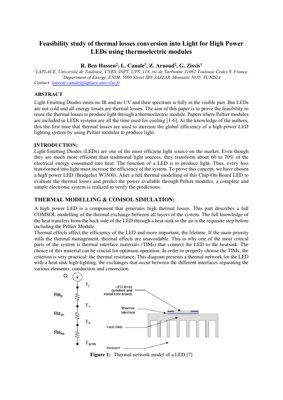
A simplified thermal resistance network model is used to analyze heat flow, as shown in Figure 1 of the PDF. The key parameters are:
- $Q$: Heat flow from hot to cold.
- $T_j$, $T_c$, $T_h$, $T_{amb}$: Temperatures at the junction, case, heatsink attachment, and ambient, respectively.
- $R_{\theta jc}$, $R_{\theta ch}$, $R_{\theta ha}$: Thermal resistances between these points.
The overall junction-to-ambient resistance is given by:
$R_{\theta, J-amb} = \frac{T_j - T_{amb}}{P_d}$ [1]
And it can be decomposed as:
$R_{\theta, j-amb} = R_{\theta, j-c} + R_{\theta, c-h} + R_{\theta, h-amb}$ [2]
Where $P_d$ is the dissipated power. Minimizing these resistances is crucial for creating a sufficient temperature gradient ($\Delta T$) across the TEG.
3.2 COMSOL Simulation Results
Simulations compared the thermal profile of the LED system with and without the integrated thermoelectric module (Figure 2 in PDF). The model with the TEG showed a modified heat flux path, confirming that a portion of the thermal energy could be intercepted and converted before being dissipated to the heatsink and ambient air. This validated the conceptual placement and potential of the TEG.
4. Experimental Setup & Results
The theoretical model was validated through physical prototyping.
4.1 Prototype with Single TEG
The first prototype (Figure 3 in PDF) consisted of the Bridgelux LED, a single TEG, and a heatsink. It successfully generated electrical output from the LED's waste heat: $V = 1V$, $I = 300mA$. However, this voltage was below the forward voltage (typically ~1.6V) required to illuminate a standard red LED, demonstrating a key challenge: achieving a sufficient $\Delta T$ for practical voltage levels.
4.2 Prototype with Dual TEGs in Series
To overcome the voltage limitation, a second TEG was added in series with the first. This configuration increased the total open-circuit voltage, making it possible to successfully light an auxiliary LED. This experiment proved the core feasibility: waste thermal energy from the primary LED can be converted into electricity to produce additional light.
5. Technical Analysis & Framework
Core Insight: This paper isn't about a marginal efficiency gain; it's a foundational challenge to the design philosophy of high-power photonics. The industry's obsession with thermal management has been purely defensive—sinking heat to protect the LED. This research flips the script, proposing an offensive strategy: weaponizing the thermal gradient. It treats the LED's thermal footprint not as a liability but as a secondary, parasitic power bus. The real innovation is the conceptual integration of a micro-scale combined heat and power (CHP) system within a single lighting fixture.
Logical Flow: The logic is elegantly linear but reveals a harsh reality. 1) LEDs waste 60-70% energy as heat. 2) Thermoelectrics convert heat differentials to electricity. 3) Therefore, strap a TEG to an LED. However, the flow stumbles at the energy quality conversion. The Seebeck effect is notoriously inefficient (often <5% for such low $\Delta T$). The paper's experimental results (1V, 300mA from a 64W-equivalent LED) lay bare the brutal math: the recovered electrical power is a tiny fraction of the thermal loss. The "feasibility" demonstrated is more thermodynamic than economic.
Strengths & Flaws: The strength is its visionary, cross-disciplinary approach, merging solid-state lighting with energy harvesting—a synergy often discussed in theory (e.g., in reviews from the U.S. Department of Energy's lighting R&D program) but rarely implemented. The experimental proof-of-concept is clear. The fatal flaw is the current mismatch in energy densities. The power density of high-power LED heat flux is high, but the conversion efficiency of affordable, room-temperature TEGs (like Bi2Te3 modules) is abysmally low. The added cost, complexity, and potential reliability issues of the TEG and its power management circuit may never be justified by the minuscule amount of recycled light. It risks being a "clever" solution in search of a viable problem.
Actionable Insights: For this to transcend a lab curiosity, research must pivot. 1) Material Frontier: Focus must shift to novel thermoelectric materials (e.g., skutterudites, half-Heuslers) or nanostructured composites that promise higher ZT values at near-room-temperature gradients, as explored in advanced materials journals. 2) System Co-Design: LEDs and TEGs cannot be bolted on. We need monolithic co-design—LED packages engineered from the ground up with integrated thermoelectric structures, optimizing both photon emission and phonon harvesting. 3) Niche First: Target applications where heat is truly "free" and valuable, and efficiency trumps cost. Think aerospace or underwater vehicles where every watt of electrical load saved is critical, and waste heat is abundant. The broad commercial lighting market will remain out of reach until the fundamental thermodynamics improve by an order of magnitude.
Analysis Framework Example
Case: Evaluating Viability for Street Lighting
Step 1 - Energy Audit: A 150W LED streetlight dissipates ~100W as heat. Assume a $\Delta T$ of 40°C across a heatsink.
Step 2 - TEG Performance Mapping: Using a standard TEG datasheet (e.g., TEC1-12706), the Seebeck coefficient $\alpha$ ~ 0.05 V/K. Theoretical $V_{oc} = \alpha \cdot \Delta T \cdot N$ where N is couple pairs. For 127 pairs, $V_{oc} \approx 0.05 * 40 * 127 = 254V$ (open-circuit, impractical). Actual maximum power point voltage is much lower.
Step 3 - Power Calculation: Maximum output power $P_{max} = (\alpha^2 \cdot \Delta T^2 \cdot N) / (4 \cdot R)$ where R is internal resistance. Even with optimistic numbers, $P_{max}$ is often <5W for such a setup.
Step 4 - Cost-Benefit Analysis: Adding $50-$100 of TEGs and power conditioning to recover <5W (a 3% effective system gain) has a payback period exceeding the fixture's lifetime. This framework quickly identifies the economic barrier.
6. Future Applications & Directions
The immediate application is limited to niche, high-value systems where energy recycling justifies cost and complexity, such as in remote, off-grid lighting powered by batteries or in enclosed environments where reducing thermal load is doubly beneficial.
Future research directions should focus on:
- Advanced Thermoelectric Materials: Integrating high-ZT materials like nanostructured bismuth telluride or novel polymers that operate efficiently at lower temperature gradients.
- System-Level Integration: Designing LED packages with built-in thermoelectric layers, moving away from discrete, add-on modules.
- Hybrid Energy Harvesting: Combining thermoelectric conversion with other methods, such as converting a portion of the LED's own emitted light via photovoltaic cells for ultra-high-efficiency closed-loop systems.
- Smart Power Management: Developing ultra-low-loss DC-DC converters specifically designed to handle the low-voltage, variable output from TEGs to efficiently drive auxiliary LEDs or charge buffers.
7. References
- [1-6] Various studies on Peltier modules for LED cooling (as cited in the original PDF).
- U.S. Department of Energy. (2023). Solid-State Lighting R&D Plan. Retrieved from energy.gov.
- He, J., & Tritt, T. M. (2017). Advances in thermoelectric materials research: Looking back and moving forward. Science, 357(6358).
- Zhu, H., et al. (2022). High-performance near-room-temperature thermoelectric materials. Nature Reviews Materials, 7(6).
- Bridgelux. BXRA-W3500 Data Sheet. [8] in original PDF.
- COMSOL Multiphysics®. www.comsol.com.